
Do you want to know why the usage of calcium silicon(CaSi) in the steelmaking industry is significantly lower than ferrosilicon(FeSi), ferro-manganese(Fe-Mn), and silicon-manganese(SiMn)? The answer is simple yet fundamental: unlike these bulk ferroalloys, calcium silicon (CaSi) is not applied in the primary steelmaking stage for crude steel. Instead, its domain is the refined world of high-quality steel, stainless steel, rail steel, and other high-end steel products.
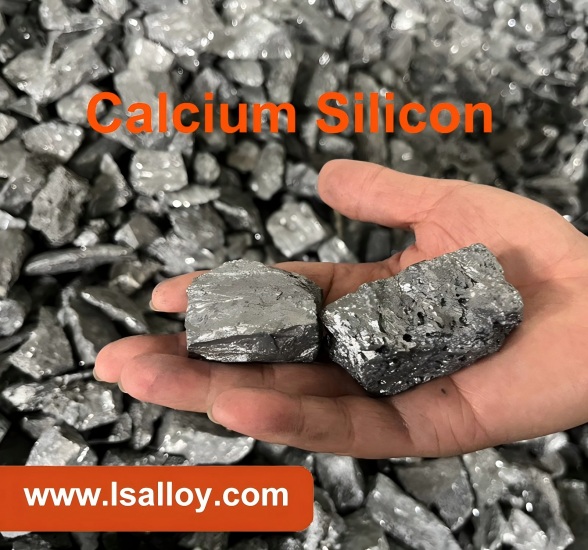
Why Calcium Silicon (CaSi) Cannot Be Used in Crude Steel?
Applying calcium silicon in a basic oxygen furnace (BOF) or electric arc furnace (EAF) during the production of crude steel is both technically ineffective and economically prohibitive. This is due to two primary factors: the physical properties of calcium and the chemical environment of crude steel.
1. The Physical Property: The Boiling Point Dilemma
The core issue lies with calcium's low boiling point.
Calcium Boiling Point: ~1484°C
Crude Steel Temperature: 1600°C - 1700°C
When calcium silicon is a niche alloy for high-end steel, used in secondary refining for inclusion modification, not in crude steelmaking is introduced into molten crude steel, the calcium component instantly boils and vaporizes.
This violent gasification leads to three major problems:
??Extremely Low Yield: The vast majority of the expensive calcium vaporizes and escapes from the steel before it can dissolve and react, resulting in a yield of less than 10%.
??Safety Hazards: The sudden generation of a large volume of gas causes violent agitation and splashing of molten steel, posing a significant risk to equipment and personnel.
??Non-uniform Reaction: The vaporization prevents calcium from distributing evenly, making any controlled chemical reaction impossible.
2. The Chemical Environment: A Wasted Reaction
Crude steel, fresh from the primary smelting process, has high concentrations of dissolved oxygen and sulfur. Calcium is an extremely potent deoxidizer and desulfurizer. If added at this stage, it would be consumed by these high levels of O and S, forming calcium oxide (CaO) and calcium sulfide (CaS). This is a highly inefficient use of an expensive alloy, as the same job can be performed far more economically with common deoxidizers like ferro-silicon or aluminum.
3. The Economic Impossibility
Combining the near-total loss of calcium through vaporization with its wasteful consumption by excess oxygen and sulfur results in a catastrophic cost-to-benefit ratio. It is simply not a viable process for any steelmaking operation focused on cost control.
Calcium Silicon's Critical Role in High-End Steel
The true stage for calcium silicon is secondary steelmaking (or ladle refining). At this stage, the steel has a lower temperature and, crucially, much lower levels of oxygen and sulfur. CaSi is typically introduced using cored wire feeding technology, which injects the alloy deep into the ladle, protecting it from the atmosphere and slag and maximizing its dissolution and recovery.
In this controlled environment, calcium performs two critical functions that are essential for producing high-performance steel.
1. Primary Function: Inclusion Modification
This is the most important reason for using CaSi. In steel deoxidized with aluminum, the primary non-metallic inclusions are solid, angular clusters of aluminum oxide (Al?O?). These inclusions are detrimental:
They act as stress concentrators, severely reducing the steel's toughness and ductility, especially in the transverse direction.
They can clog the nozzle during continuous casting, disrupting production.
Calcium modifies these harmful inclusions. It reacts with the Al?O? to form complex, low-melting-point calcium aluminates (e.g., 12CaO·7Al?O?). These new inclusions are:
Globular in Shape: They are round and soft, causing far less stress concentration.
Homogeneously Distributed: They remain finely and evenly dispersed throughout the steel matrix.
2. Key Advantages from Inclusion Modification:
Enhanced Mechanical Properties: Significantly improves cleanliness, transverse toughness, and ductility.
Improved Machinability: Softer, rounder inclusions are less abrasive to cutting tools.
Prevention of Nozzle Clogging: Ensures stable and continuous casting operations.
3. Secondary Function: Deep Desulfurization
In the low-oxygen environment of the ladle furnace, calcium exhibits a very strong affinity for sulfur. It can achieve deep desulfurization, reducing sulfur content to extremely low levels (<0.005%), which is critical for applications like high-strength pipeline steel and shipbuilding steel.
Conclusion: "Niche" Means Specialized
Calcium silicon is called a niche alloy because its use is highly specialized, targeted, and indispensable for premium products.
Its application requires specific technology (cored wire feeding), a controlled environment (secondary steelmaking), and a deep understanding of metallurgy. While its volume is small compared to ferro-silicon, its impact on the quality, performance, and value of the final steel product is immense. For any producer of high-quality steel, CaSi is not just an option; it is a critical component in the quest for metallurgical excellence.